
Sense-making in the paperwork
Do we have the same conceptual map of the organisation's documents? What if Strategy is just missing?

In one of my Boards, we were getting into a conversation about how to ensure decisions are optimal rather than simply being the average of our opinions on this day? A key question for me became What do we look to in order to refine a conversation, focus attention and take a decision? Lots of documents exist: what are they, who owns them, why have them, what’s missing, are they useful with this question before us today?
What became difficult was that there were:
a fuzzy definition of certain concepts - “A Strategy is like a long-term Plan”
competing definitions - “A Vision is X” … “No, that’s a Mission. A Vision is Y”
Specific expertise-based definitions - “Our Purpose is Clause 2 of our Constitution, this paragraph be called our Purpose”
I produced a version of this diagram to assist conversations in our Board. I have since refined it and used it to assist a couple of other Boards and individual Directors. Here you go:
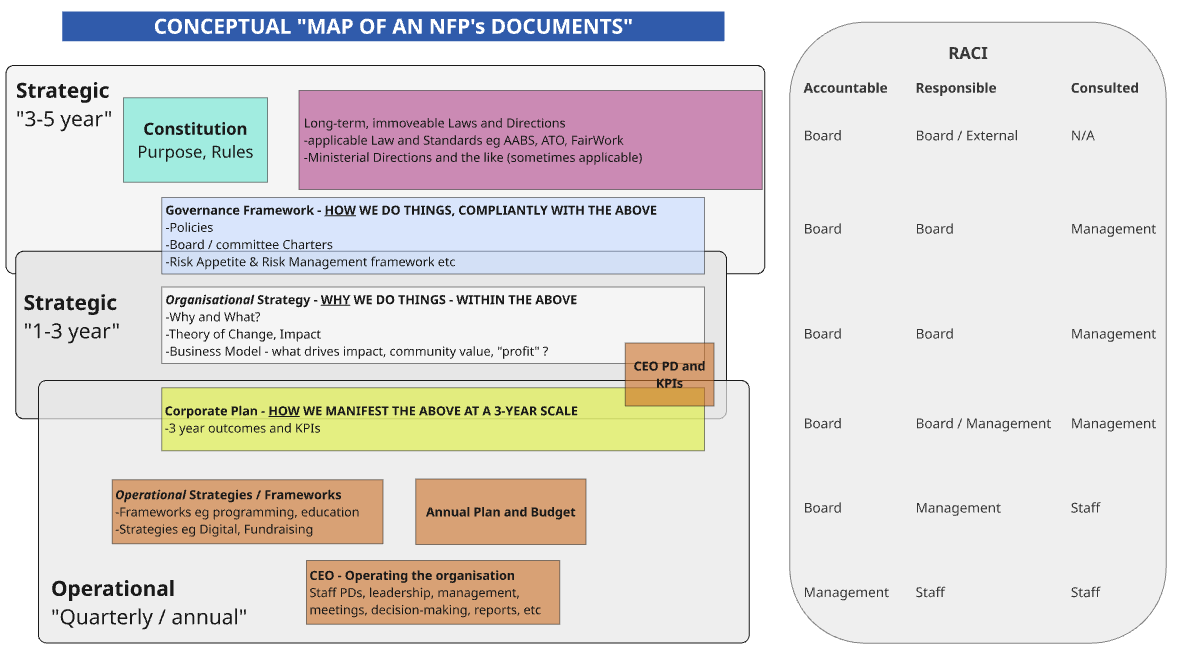
It highlighted to me that a productive “Strategy” or “Governance” conversation requires agreeing on a shared meta-reality. Otherwise we find ourselves discussing up and down the hierarchy all at once - like talking ingredients, dishes, menus, restaurants and then even whether we are hungry while sitting in Nandos.
So for me a key step before discussing things, or taking decisions, embarking on a policy review or a planning session, is to agree what our version of this diagram is.
Why is this hard?
People get their definition from a few places:
Their last role
Their training in a subset of these being somewhat myopic about the others (AICD talks Governance but don’t really see operationalisation, BigFourPartners bring up Strategy ‘thought leaders’ but don’t think through Constitutions)
This is how we’ve always done it
LinkedIn zombie thought leadership - starting with Why? sounds great!
None of these talk about power, or context, or of utility. It is much more important is to ask
What is the hierarchy of X and Y?
Who owns X?
Who uses X, and to do what?
Never mind the MBA textbook, what do we actually need here? (Balls to “Best Practice” as one Chair told me recently!)
When do we use X - perpetually, annually, weekly?
Where do we go if X doesn’t do the job I thought it did?
How, and by whom, will the utility of X be measured?
Doing this takes time, distance and reflection, and needs a view of the entire system. It’s impossible to see when you are in it; there’s a reason the football coach is watching the game, not playing on the field. Good consultants can help, but they are rarely asked to, nor incentivised to raise it - bill the time, move on. Boards ask for a Strategic Plan, or undertake a Board Performance Review, recruit a CEO - all with a different consultant.
As an illustration, after working with multiple organisations internally and externally over the past five years, I created an illustration of the specific impacts of absent (not poor) Strategy.
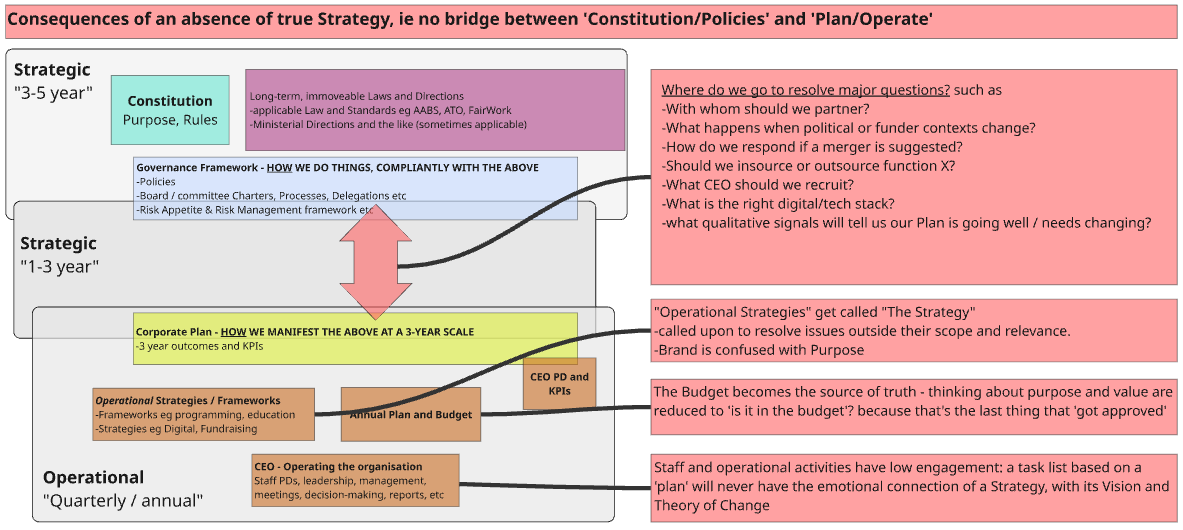
In nearly every case, this has been because Strategy and Plan have been elided into Strategic Plan. I have written about this before (Strategic Planning is Neither) and have the same view of it as my eyes have of grass pollen - it hurts and it brings me to tears. To extract the points from the diagram,
Where do we go to resolve major questions?
With whom should we partner?
What happens when political or funder contexts change?
How do we respond if a merger is suggested?
Should we insource or outsource function X?
What CEO should we recruit?
What is the right digital/tech stack?
what qualitative signals will tell us our Plan is going well / needs changing?
"Operational Strategies" get called "The Strategy"
They get called upon to resolve issues outside their scope and relevance.
Brand is confused with Purpose
The Budget becomes the source of truth
thinking about purpose and value are reduced to 'is it in the budget'? because that's the last thing that 'got approved'
Staff and operational activities have low engagement
a task list based on a 'plan' will never have the emotional connection of a Strategy, with its Vision and Theory of Change
Conclusion
So much unproductive conflict and disengagement stems from a misalignment of basic conceptual frames. Foundational to success is living in the same reality. Leaders are skipping over this crucial check-in and getting stuck in a world of unvocalised assumptions.
Fin
There are so many things I am thinking about in this space, and could have written about in reference to this diagram.
The tyranny of over-simplified diagrams (you know, a Venn of Platitude, Challenge, Emotion with the word Leader in the middle) that suggest things are simple when they are not
Our cultural insistent that linear texts (the Board Paper or the Leadership Book) are the superior forms of explanation when diagrams and practical application generate more value every time
What about when something else is missing eg Policies, or operational framework
How NFP-land is far more complex than FP land
How do these flow over time- what is the cadence of each these and how do they synchronise?
When the Board drift or drive downwards, or the CEO drifts or drives upwards
What about when one of the boxes is oversized and dominates the others?
When I see it’s all there but the org still isn’t thriving, where/how do i start?
How does this diagram explain why you left the Museum sector, Paul?
Tell me what you want next. Helpful opinions on demand, with a side order of mild snark, that’s me. It’s my Constitution.
Until next biweek.
Paul.